



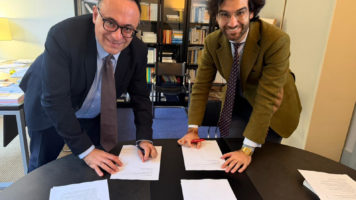

Paris (France), 11th December 2025 | UNESCO recently hosted the International Symposium on the Future of the Right to Education: Renewing Global Commitments and Charting Future Directions at its Headquarters in Paris. The event marked the 65th anniversary of the 1960 Convention against Discrimination in Education, served as the official closing of the 11th Consultation on the Convention, and included the launch of the 2025 Global Report on the Right to Education.
The Symposium brought together policymakers, international organizations, academics, and civil society representatives to reflect on global progress, examine ongoing and emerging challenges, and renew momentum around the universal right to education.
OIDEL was represented by its Director, Ignasi Grau, who delivered an intervention emphasizing the growing importance of pluralism and trust in contemporary education systems, which are being reshaped by digitalisation, displacement, and broader societal transformations. In his remarks, he noted that these changes create genuine opportunities to build education systems that are more pluralistic and more relevant to diverse communities, but also pose significant risks. He warned that non-mainstream groups may face increasing discrimination, and that culturally relevant education might become accessible only to those who belong to mainstream communities or have sufficient resources. Preventing this divide is essential to ensuring intercultural dialogue on equal footing and education that is truly rooted in one’s culture.
Mr. Grau recalled that UNESCO’s 2015 report “Rethinking Education: Towards a Global Common Good?” had already warned that the traditional public–private distinction was no longer sufficient to address emerging challenges to the right to education. He underscored that, in an increasingly plural world, trust must become a central concept. Children flourish within families, communities, and cultural environments, and for this reason, parents and civil society must be placed at the centre of education discussions. He concluded by advocating for frameworks in which all actors in the educational ecosystem can meet evolving minimum requirements while still allowing parental and civil society initiatives to flourish.